

Alasdair’s Engineering Pages © A. N. Beal 2025 www.anbeal.co.uk



www.anbeal.co.uk



Concrete September 1981
Secondary dead load and the limit state approach
by Alasdair Beal
Alasdair Beal was formerly a site engineer with Fairclough Building Ltd and now works for Structures and Computers Ltd.
Although the first limit state code, CP110, has been with us for some nine years and now its counterparts for other types of structures and building materials have started to appear, the limit state approach is still controversial and some way away from universal acceptance. This article is not intended to argue for a wholesale rejection of the approach, that has been done elsewhere [1], but to explore one aspect of it -
Instead of relying on the traditional single ‘global’ safety factor, limit state codes adopt a ‘partial factor’ format, dividing the safety factor into a series of sub-
It is proposed that statistically-
Statistics can be gathered for the many things which can vary in a structure -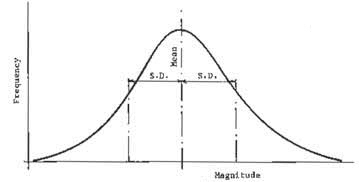 ion.
ion.
The standard deviation is a measure of variability, for the commonly employed ‘Normal’ (Gaussian) Distribution, a band extending one standard deviation to each side of the mean will enclose 68 % of results and two standard deviations to each side of the mean will enclose 95%.
If we wish to calculate the value of a load which has a given certainty of not being exceeded, this can be done. Once the mean value and the standard deviation of its variation have been worked out, the required value will he obtained by adding an appropriate multiple of the standard deviation to the mean value. The more variable the load is, the larger its standard deviation will be and thus the higher the calculated load factor. Thus it should he possible to derive a separate safety factor which is appropriate to each type of loading and which gives a consistent, known probability of failure for each.
In this approach, points which require thought are:
(a) how should the statistics be compiled and interpreted?
(b) can the safety factor required to cover variations always be expressed as some constant multiple of the design load?
Secondary dead load seems appropriate for detailed consideration, it is allocated the highest load factor in BS5400 and variations in secondary dead load have been a contributory cause in several recent collapses (e.g. the Ilford High School swimming pool roof collapse in 1974 [2]. The term ‘secondary dead load’ covers many different things -
Statistics
The sheer variety of materials and circumstances sets a formidable challenge to the gatherer of statistics: however, once these have been gathered there still remains the problem of interpreting them. To assess the variability of loadings, all the different weight measurements in the survey must he compared with a set of nominal values for each type of load. What are these nominal values to be? For ordinary dead load they are quite easy to select, e.g. the measured weights of all the floor slabs which were intended to be 6in thick will be compared with the theoretical weight of a 6in floor slab. However, for secondary dead load, matters are confused by the fact that this can sometimes be changed during the life of a structure, e.g., re-
If the former approach is followed, then many of the deviations which may be of the greatest importance will be excluded: the variations found will generally be modest. if the latter approach is taken, some quite large deviations will show up but the statistics will be heavily influenced by the performance of the designers, how carefully materials have been specified, how well they have predicted likely loadings and whether or not they have seen fit to provide some margin to cover future alterations if these seem likely or possible. The study might come perilously close to being an assessment of variations in designers rather than in materials, something which would sit uneasily with the widely expressed view that codes of practice cannot and should not try to cover ‘designer error’.
Neither approach seems altogether satisfactory but a choice must be made between them before the statistics can be interpreted. The load factors which are calculated will depend heavily on that choice.
What really happens?
Reflection on the different ways in which secondary dead load may vary in practice from the intended value suggests that the probabilistic treatment outlined is not a very satisfactory answer. As an example, consider the roof of a building; if it is well looked after and repair work is always done carefully, using the load will be consistent and reliable. As the weights of the materials can generally be quite accurately estimated, it would be wrong and unnecessary to apply a higher load factor than those used on other loadings. Those cases where secondary dead load does vary are commonly brought about by alterations, by badly done (or not done) repairs or by re-
In the same way, if a bridge is carefully maintained and uses proven materials, it should not suffer substantial changes in secondary dead load during its life. On the other hand, if the roadway is resurfaced without first stripping off the existing surface or if a decision is taken, say, to replace epoxy surfacing with mastic asphalt, the change in loading is large and unpredictable.
If we think of most categories of secondary dead load, the situation appears to be similar, where care is taken, the loading is known and predictable but where a substantial change does occur, the resulting loading may bear no relationship whatsoever to the original design value. In the former case, a high load factor could not be justified; in the latter, it would not be possible to derive a ‘rational’ factor, high or low, because the assumed and actual values may be completely unrelated to one another. Regardless of the quantity of the statistics gathered or the amount of analytical work done, the quest for some ideal value of the load factor as a solution to the problem is futile.
Conclusions
To leave the matter here would not do; variations in secondary dead load can be a problem and as stated earlier, they have contributed to some recent collapses. Something which may help is that, although a designer may divide up a structure's safety margin by splitting the overall safety factor into a series of partial factors, the structure itself does not so perform, thus variation of one load exceeds the allowance made in its load factor, this need not cause collapse of the structure -
References
1. Beal, A N. ‘What’s Wrong with Load Factor Design?’, Proceedings of the Institution of Civil Engineers Part 1, Nov. 1979, pp. 595-
2. Mayo, A P. An investigation of the collapse of a swimming pool roof constructed with plywood box beams, Building Research Establishment CP 44/75.
This paper is reproduced by kind permission of
The Concrete Society
www.concrete.org.uk
